
 Trip.com




 Klook
Klook







The worst month to visit Okinawa is September
September is statistically the most typhoon-disrupted month in Okinawa. It is the wettest month of the year (245mm), still hot and humid at 31°C, and squarely in the Pacific typhoon track — the islands sit between the Philippine Sea, where storms form, and the Japanese mainland, where they head. A direct hit closes Naha Airport, grounds every inter-island flight, and stops the ferries to Zamami, Ishigaki, and the Kerama Islands for two or three days.
The important nuance: a typhoon does not have to hit Okinawa to ruin a trip there. A storm passing 300km away still brings a day of rough seas, closed beaches, and cancelled boat tours — and September averages several such passes.
Why July through September is genuinely difficult
- July — heat and building risk. 32°C with 27°C nights and 75%+ humidity. Rainfall is modest on paper (140mm), but typhoon disruption escalates through the month and inter-island flights cancel regularly.
- August — multiple typhoons on average. The hottest month, 240mm of rain, and the peak of storm frequency. Eisa drum-and-dance festivals run all month at shrines and town squares — spectacular, but weather-dependent.
- September — the most disrupted month. As above. Track every system at the Japan Meteorological Agency; Okinawa is usually the first Japanese territory in a storm's path.
- June — the rainy season (tsuyu).Okinawa's rainy season runs from late May to mid-June, earlier than the mainland, with 250mm of rain. Box jellyfish (habu kurage) nets go up on beaches in June and stay until October.
The other "wrong" time: Golden Week and the winter swim gap
- Golden Week (April 29 – May 5):Okinawa is Japan's domestic beach escape, and the year's biggest holiday week fills every resort on the main island at peak rates. The weather is excellent — the problem is purely crowds and cost.
- December – February:Mild (19–21°C) and dry, but the sea drops to 22–23°C and most visitors will not swim. Whale watching (January–March) and Japan's earliest cherry blossoms (late January) are the winter draws — just not the beach.
If you have to travel in typhoon season, here's what to do
- Stay on the main island, not the outer islands. Naha and the Onna-son resort coast keep hotels, restaurants, and the aquarium running through a storm; Ishigaki, Miyako, and the Keramas can be cut off for days.
- Buy travel insurance with weather coverage — cancelled inter-island flights and ferries are the most common typhoon-season claim in Japan.
- Book a resort with a covered pool and a reef-sheltered beach. Days after a storm pass bring rough open water even under blue skies.
- Front-load the boat trips — snorkelling at the Blue Cave or the Keramas on day one, not day five.
- Keep an indoor list:Churaumi Aquarium, Shuri Castle, the Okinawa World caves, and Naha's Makishi Market cover two wet days comfortably.
Better windows: when to visit instead
- October: Widely considered the best month — typhoon risk fades, the sea is still 27°C, humidity drops, and the Naha Great Tug-of-War fills the Sports Day weekend.
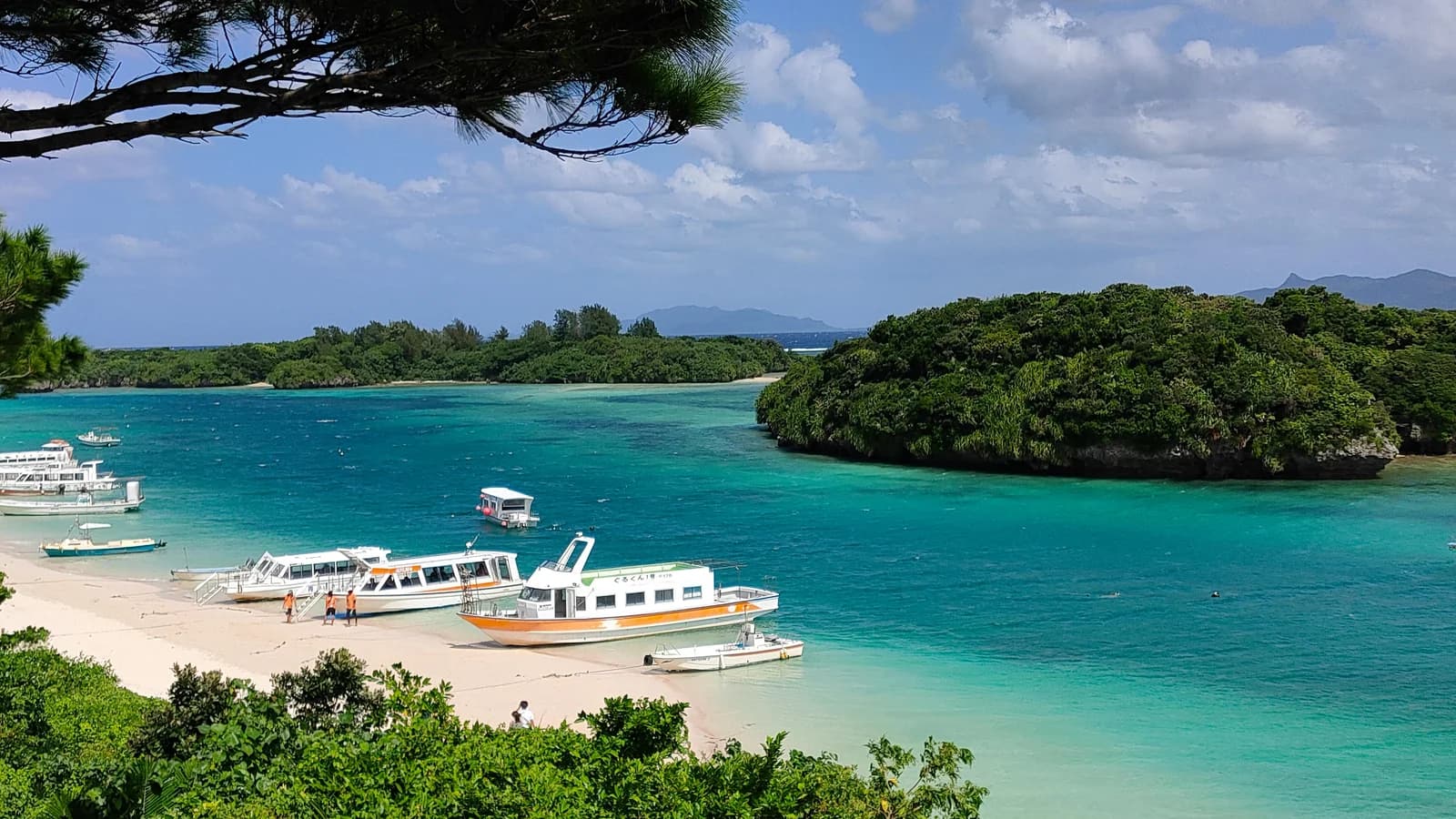
- November: Perfect 24°C air, 25°C sea, the clearest water of the year at Kabira Bay on Ishigaki, and hotel rates dropping sharply from mid-month.
- April – mid-May: Beach season opens April 1, the water is warming, and it is dry and quiet — until Golden Week.
Click any month on the seasonality map above for the full climate detail and our verdict.
Your Okinawa cheat sheet
One email with the whole year in it — and the questions that actually change a trip there, answered.
- All 12 months scored 0–100
- The months to skip, and when it turns good again
- The questions that change the plan, answered
- Plus the Travel Timing Calendar 2027: every destination, every month (PDF)
We'll email you your cheat sheet with the Travel Timing Calendar, plus occasional travel-timing guides. Unsubscribe anytime; see our privacy policy.
The year at a glance
Twelve months, three seasons
Each cell is one month. Lemon means peak, sky means shoulder, gray means avoid. The outlined cell is the current month.
Atlas Ranger Score · proprietary
When Okinawa scores best, month by month
Our transparent 0–100 score blends weather comfort, crowds, value and festivals into one number per month. How it's calculated →
- Best monthMay 59
- Best valueDecember 67 off-peak
- ToughestSeptember 43
See how Okinawa ranks against every destination on the Best Time to Travel leaderboard →
Explore the map
Every city, every month
Drag the month scrubber, hover any city, read the headline for that window.
Storms near Okinawa right now
- Super Typhoon Champi430km NW of here, winds 50ktJoint Typhoon Warning Center →
Okinawa vs Nearby Destinations
vs Tokyo
Different climate and trip entirely. Tokyo is humid subtropical urban Japan; Okinawa is full subtropical island Japan. Combine them across seasons — Tokyo in April or November, Okinawa in May or October. Don't use Okinawa as an August heat escape from Tokyo (it's hotter and has typhoon risk) — Hokkaido is the actual cool-summer alternative.
vs Kyoto
Different worlds. Kyoto is cool-to-cold inland Japan with deep traditional culture; Okinawa is subtropical island Japan with Ryukyu heritage and beaches. Both work well in shoulder seasons (Kyoto in late November for koyo, Okinawa in November for post-typhoon beach) so a 10-day Japan trip can do both.
vs Bali
Beach-trip alternative comparison. Bali has a cleaner wet/dry split (dry May-September, wet December-March) while Okinawa is more typhoon-affected. Bali is hotter year-round (29-32°C vs 24-30°C peak). Pick Okinawa for Japan + beach combo trips; pick Bali for a dedicated tropical vacation. Okinawa runs more expensive (Japan pricing) but visa-free for most travelers.
Airport transfers, money, water, connectivity and which areas to stay in are covered once, on the Okinawa best-time guide. Need data in Japan? Compare plans in the best eSIM for Japan guide.
Frequently asked questions
When is typhoon season in Okinawa?
What is the weather like in Okinawa in October?
Is June a bad time to visit Okinawa?
What is the best month to visit Okinawa?
What is the worst month to visit Okinawa?
When is the rainy season in Okinawa?
How many days do you need in Okinawa?
When is the cheapest time to visit Okinawa?
Is Okinawa safe for tourists?
How does Okinawa weather compare to mainland Japan?
When can you see whales in Okinawa?
Keep planning
Plan your Okinawa trip
Sources
Every claim on this page is backed by an authoritative source. Atlas Ranger synthesizes data from multiple references so you can see exactly where each fact came from.
- Okinawa Convention & Visitors BureauUsed for: Official tourism guidance, festival timing, beach swimming season dates.
- Japan Meteorological Agency — Naha NormalsUsed for: Climate normals (1991-2020) for temperature, rainfall, and sunshine hours.
- JMA Typhoon DatabaseUsed for: Historical typhoon landfall and approach data for Ryukyu Islands.
- JNTO — OkinawaUsed for: Editorial seasonal guidance from Japan National Tourism Organization.