 Trip.com










 Klook
Klook






The worst month to visit Kyoto is August
August is Kyoto's hottest month, and Kyoto's heat is a different animal from Tokyo's. The city sits in a basin ringed by mountains on three sides; the air does not move, and afternoons of 35–37°C are routine even though the monthly average reads 33°C. Nights stay at 24°C. Temple gardens that are transcendent in November are simply an endurance test at 2pm in August.
The one reason to be here: Gozan no Okuribi (Daimonji) on August 16, when five giant bonfires are lit on the hills around the city to close Obon. It is the single most atmospheric night of the Kyoto year — and it falls inside the Obon travel crush (August 13–15), when trains and rooms are at their scarcest.
Why July through September is genuinely difficult
- July — Gion Matsuri plus the rainy season's tail.Kyoto's defining festival runs all month, peaking with the yamahoko float parades on July 17 and 24. It is magnificent, and it coincides with 31°C heat, 75%+ humidity, and 220mm of rain. Gion accommodation books six months ahead.
- August — basin heat and Obon.As above. Heat-stroke advisories are common; the Philosopher's Path and Fushimi Inari's mountain trail are best avoided in the afternoon.
- September — typhoons and lingering heat. 180mm of rain and periodic typhoons crossing western Japan. Kyoto takes less direct damage than the coast, but Kansai International Airport closes, trains stop, and temples shut for the storm day. Track systems at the Japan Meteorological Agency.
- June — the rainy season. Wetter than Tokyo at 220mm, mostly overnight rain and morning drizzle. Hotel rates fall and the hydrangeas at Mimuroto-ji are superb — the best of the bad months if you can accept grey skies.
The other "wrong" time: peak seasons without a booking
Kyoto's two great windows — cherry blossoms (roughly April 1–10) and autumn leaves (mid-to-late November) — are the best time to visit and the hardest to book:
- Hotel rates climb well above normal; ryokan in Higashiyama sell out earlier than anywhere else in Japan
- Kiyomizu-dera, Arashiyama, and Fushimi Inari are shoulder-to-shoulder from mid-morning
- Buses on the main tourist routes are full by 9am
Book six months ahead or shift to October, which has similar weather and noticeably fewer visitors than November.
If you have to travel in summer, here's what to do
- Start at 6am. Fushimi Inari and the Arashiyama bamboo grove are empty and bearable at dawn; both are miserable at noon in August.
- Go north for the afternoon.Kurama, Kibune, and Ohara sit in the hills and run several degrees cooler. Kibune's kawadoko riverside dining platforms exist precisely for this.
- Avoid August 11–17 unless Daimonji is the point of the trip — in which case book a year ahead.
- Buy travel insurance with weather coverage for September.
- Use the evenings.Gion Matsuri's yoiyama evenings (July 14–16), Pontocho after dark, and the summer illuminations at Kodai-ji are when Kyoto summer works.
Better windows: when to visit instead
- October: 22°C days, low humidity, clear skies, early autumn colour at Kurama and Kibune, and far fewer visitors than November. Jidai Matsuri on October 22.
- Late November:Peak koyo — the city's defining month, at Tofuku-ji, Eikan-do, and the Philosopher's Path. Book six months out.
- Mid-May: After Golden Week, crowds drop while the weather peaks at 23°C and the bamboo grove is at its greenest. Aoi Matsuri on May 15.
Click any month on the seasonality map above for the full climate detail and our verdict.
Your Kyoto cheat sheet
One email with the whole year in it — and the questions that actually change a trip there, answered.
- All 12 months scored 0–100
- The months to skip, and when it turns good again
- The questions that change the plan, answered
- Plus the Travel Timing Calendar 2027: every destination, every month (PDF)
We'll email you your cheat sheet with the Travel Timing Calendar, plus occasional travel-timing guides. Unsubscribe anytime; see our privacy policy.
The year at a glance
Twelve months, three seasons
Each cell is one month. Lemon means peak, sky means shoulder, gray means avoid. The outlined cell is the current month.
Atlas Ranger Score · proprietary
When Kyoto scores best, month by month
Our transparent 0–100 score blends weather comfort, crowds, value and festivals into one number per month. How it's calculated →
- Best monthNovember 61
- Best valueNovember 61 off-peak
- ToughestAugust 56
See how Kyoto ranks against every destination on the Best Time to Travel leaderboard →
Explore the map
Every city, every month
Drag the month scrubber, hover any city, read the headline for that window.
Kyoto vs Nearby Destinations
vs Tokyo
Most travelers do both — they're 2 hours apart on the shinkansen. Tokyo for modern Japan + urban density; Kyoto for temples + traditional culture. The classic split: 4-5 days Tokyo, 3-4 days Kyoto. Both peak in cherry blossom season (April) and autumn leaves (mid-late November), so itinerary planning aligns easily.
vs Osaka
Osaka is 15 minutes by JR from Kyoto and cheaper for accommodation. Most travelers stay in Kyoto for atmosphere and day-trip to Osaka for food. Budget travelers reverse it — Osaka base, Kyoto day-trips. If you have to pick one, Kyoto for cultural depth, Osaka for food + working-class energy.
vs Okinawa
Different climate and culture. Kyoto is cool-to-cold inland Japan with deep traditional culture; Okinawa is subtropical island Japan with Ryukyu heritage and beaches. They make a great combined trip if you have 10+ days: Kyoto in November for koyo, then fly south to Okinawa for the post-typhoon beach window. Same season works for both — peak winter doesn't.
Airport transfers, money, water, connectivity and which areas to stay in are covered once, on the Kyoto best-time guide. Choosing a neighborhood? See the best area to stay in Kyoto. Need data in Japan? Compare plans in the best eSIM for Japan guide. Taking bullet trains? The JR Pass calculator shows whether a pass pays off.
Things to do in Kyoto
Self-guided tours and skip-the-line tickets you can book ahead.
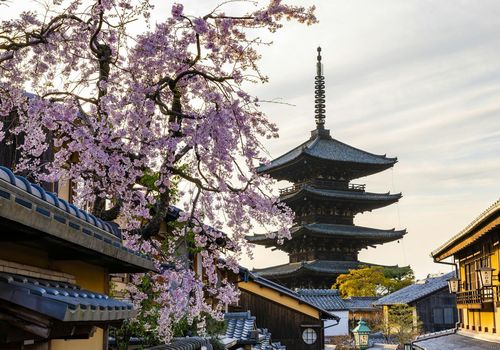


Tours & tickets via WeGoTrip — we may earn a commission, at no extra cost to you.
Frequently asked questions
What is the best month to visit Kyoto?
What is the worst month to visit Kyoto?
When is the rainy season in Kyoto?
How many days do you need in Kyoto?
When is the cheapest time to visit Kyoto?
Is Kyoto safe for tourists?
Should I visit Kyoto or Osaka first?
What should I pack for Kyoto?
Keep planning
Plan your Kyoto trip
Sources
Every claim on this page is backed by an authoritative source. Atlas Ranger synthesizes data from multiple references so you can see exactly where each fact came from.
- Kyoto City Tourism AssociationUsed for: Official tourism guidance, festival timing, temple opening hours, illumination schedules.
- Japan Meteorological Agency — Kyoto NormalsUsed for: Climate normals (1991-2020) for temperature, rainfall, and sunshine hours.
- U.S. State Department Japan Travel AdvisoryUsed for: Independent safety assessment and entry requirement reference.
- JNTO — KyotoUsed for: National tourism board coverage of Kyoto seasonal events and festivals.