The short answer for first-timers
May, October, and November are the best months to visit Okinawa.May for the "before rainy season" window with warm seas (~25°C) and clear skies; October-November for the post-typhoon recovery window with the same warmth and dramatically lower hotel prices. May is the single sweetest month — beach swimming weather, low humidity, and before tsuyu sets in.
Avoid August and September if you can.Typhoons disrupt flights, ferries, and beach days at the worst rate of any Japanese region. This isn't theoretical — in a typical year 3-7 named storms approach within 300 km of Okinawa, cancelling flights from Naha and closing ferries to the outer islands for 1-3 days at a time. September is statistically the most typhoon-disrupted month in Japan.
Okinawa is not "Japan in summer"
Okinawa sits in the subtropics, 1,000 km southwest of Tokyo. Its weather has nothing in common with Honshu:
- Winters are mild. January in Naha is 19°C — about the same as Tokyo in late April. You can wear a long-sleeve T-shirt all winter.
- Cherry blossoms come first. The vibrant pink kanhizakura blooms in late January — two full months before the Tokyo somei-yoshino bloom. Different species, different climate, different season. See our cherry blossom tracker for the national bloom sequence including Okinawa.
- Typhoon exposure is 3-5× the mainland. Okinawa sits in the western Pacific typhoon highway. June-October each year, ~7 typhoons approach close enough to disrupt travel. Tokyo gets maybe one or two with real impact.
- Sea temperature stays warm. Even January seas hover around 22°C — uncomfortable for most but warmer than most European or US beaches in mid-summer.
Beach season — when it actually works
Most Okinawan beaches officially open swimming season on April 1 and close on October 31. But the official season includes the typhoon disruption period (June through October). The dates that actually work for a beach week:
- Late April through early June(the "before rainy season" window): warm seas, low humidity, blue skies. Box jellyfish (habu kurage) nets aren't yet deployed but stings are uncommon this early.
- October through mid-November(the "post-typhoon" window): sea still ~27°C, air ~28°C, dramatically clearer skies than summer. Hotel rates drop sharply mid-November.
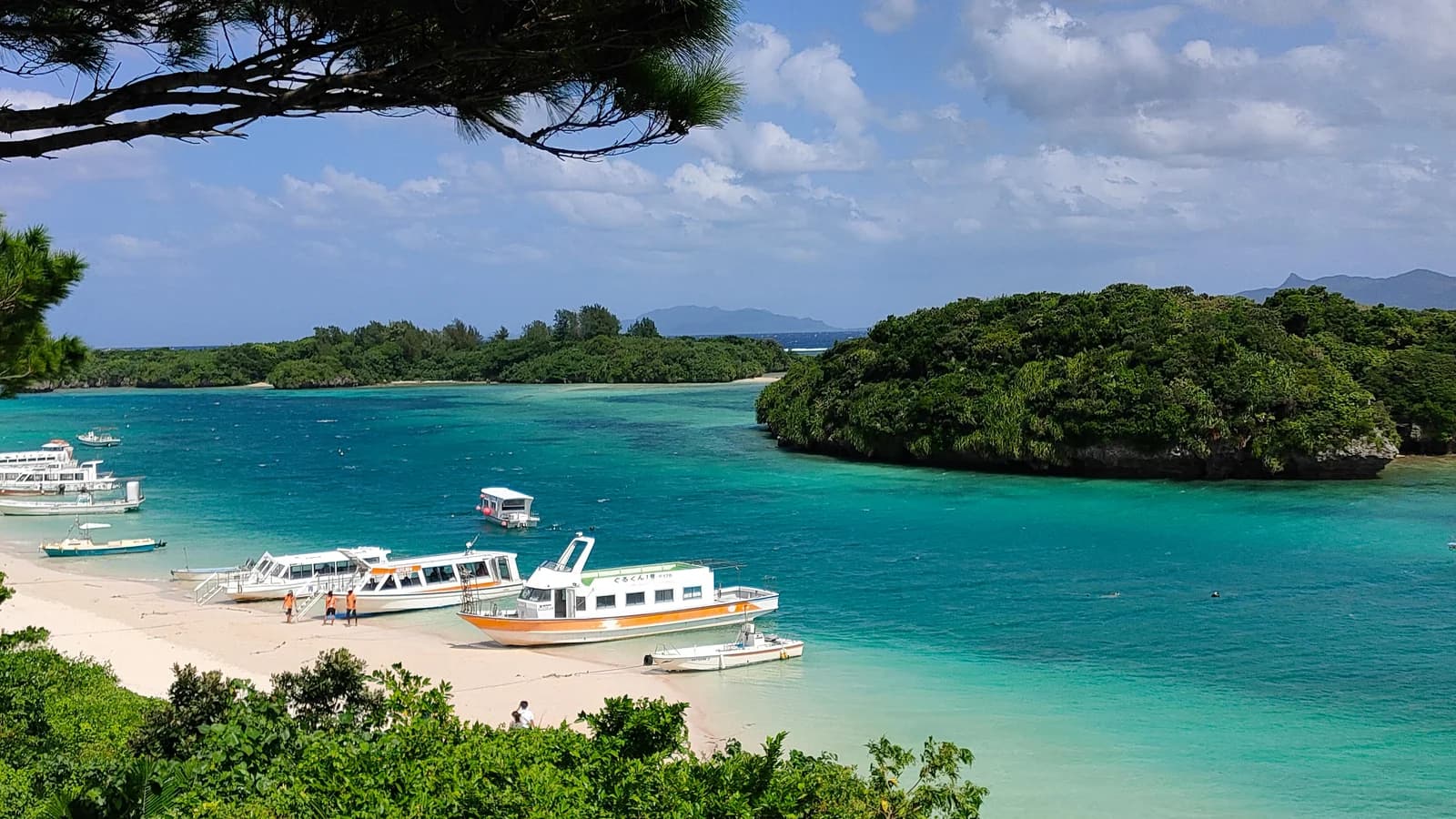
The Yaeyama islands (Ishigaki, Iriomote, Miyakojima) skew a degree or two warmer year-round than the main island, so November snorkeling clarity at Kabira Bay (Ishigaki) is the best of the entire year — and that's the actual best snorkeling in Japan.
The typhoon question — answered honestly
Typhoon season runs June to October, peaking late August and September. In a typical year, 3-7 named storms approach within 300 km of Okinawa. Direct hits cancel flights from Naha to mainland Japan (and to the outer islands), close ferries to Kerama and Yaeyama, and close beaches and snorkel boats for 1-3 days at a time.
If you have to visit in typhoon season, three rules:
- Build buffer days into your itinerary. One extra night in Naha before international flights out gives you slack if Yaeyama ferries cancel.
- Get insurance that covers weather disruptions. Standard travel insurance often excludes weather; check the policy specifics.
- Stay on the main island rather than committing to a fixed outer-island itinerary.If a typhoon hits during your Ishigaki nights, you can't reach it.
Or simply shift your trip 2-3 weeks earlier (May) or later (late October-November). The weather quality is comparable; the risk profile is completely different.
Sakura + whales — the underrated January-February window
If you can't do beach weather and don't mind 19°C, late January through February is Okinawa's quiet alternative season:
- Cherry blossoms (kanhizakura) peak the first week of February at Nago Castle Park and Mt. Yaedake — two months before the Tokyo bloom. Evening light-ups at Nago Castle Park. Vibrant pink rather than pale (a different cherry species from the mainland somei-yoshino).
- Humpback whale watchingfrom January through March. Day tours run from Naha and Zamami Island in the Kerama Islands. Best success rate is late February through early March, when whale numbers peak. Whales are protected within Japan's EEZ — Okinawa is one of the few places where commercial whale tourism is purely observational.
- Hotel prices at annual lows.Major caveats: water's too cool for casual swimming (around 22°C), the weather can swing rainy, and Okinawan winters feel cooler than the temperature suggests because of high humidity.
The outer islands shift the window
The Yaeyama islands — Ishigaki, Iriomote, Taketomi — are warmer and clearer year-round than Okinawa main island. The same general rules apply (avoid August-September), but:
- The "cool" winters are 2-3°C warmer than Naha — you can comfortably swim in February at Kabira Bay.
- November/December snorkeling clarity at Kabira Bay (Ishigaki) is the best in the country. The water in the bay is so clear that the famous manta ray dives (Manta Scramble, Manta City) report 20+ meters of visibility on good days.
- Iriomote (90 minutes by ferry from Ishigaki) has Japan's last remaining mangrove jungle and the endemic Iriomote wildcat. Best in spring (April-May) before the heat + humidity. Avoid July-September.
- Miyakojimasits between Naha and the Yaeyama. Considered Okinawa's best white-sand beaches (Yonaha Maehama, Sunayama). Calmer pace and fewer typhoon disruptions historically.
Where to base yourself
- Naha (Kokusai-dori area) for the urban base — capital city access, Shuri Castle, food + nightlife on Kokusai-dori. Best for the first/last 1-2 nights of a longer beach itinerary, or for travelers who want one base for the whole trip.
- Onna village (central west coast) for resort stays — 60-90 min drive north of Naha. Major hotels (Hilton, ANA InterContinental), family-friendly beach pools, Manza Beach and Cape Manzamo cliffs nearby.
- Cape Manzamo / Yomitan for quieter beach stays — smaller boutique hotels, surfing breaks, 30-40% cheaper than Onna for similar beach access.
- Ishigaki (Yaeyama)for the best snorkeling — 60-min flight south of Naha. Kabira Bay (clearest water in Japan), Iriomote ferry hub, manta ray dives. Best for travelers who don't mind the extra flight for top-tier diving.
- Miyakojima for beach perfection — 40-min flight from Naha. Calmer pace, fewer typhoon disruptions, the most photogenic white-sand beaches in the country.
Getting there + practical notes
Naha Airport (OKA) is the main hub. Direct flights from Tokyo (2.5h), Osaka (2h), Seoul, Taipei, Hong Kong, Manila, and Bangkok. Domestic carriers (JAL, ANA, Peach) plus Asian budget carriers (Jetstar Asia, Cebu Pacific, AirAsia). Inter-island flights to Ishigaki, Miyakojima, and Kume run multiple times daily from Naha but cancel routinely during typhoons.
Rental car is the standard for travelers exploring outside Naha — the main island is long and thin (~100 km), with limited public transit outside the capital. The Yaeyama islands have small but workable bus networks. Many ferries to the outer islands depart from Naha's Tomari Port (Kerama Islands, Tokashiki, Zamami).
The honest verdict
Okinawa is one of Japan's most rewarding off-the-mainstream-trail destinations — the culture is genuinely different (Ryukyu Kingdom heritage, distinct cuisine, traditional textiles), the beaches are world-class, and the climate offers an actual tropical Asia experience inside Japan's safety + infrastructure umbrella.
For most travelers the answer is unambiguous: visit in May or October-November. Avoid August-September unless you can build buffer days and weather insurance into the trip. For travelers who can only do winter dates, late January-February delivers a quiet alternative — cherry blossoms before any mainland city, whale watching, and the lowest hotel rates of the year.
Most strategically, Okinawa combines beautifully with mainland Japan trips across different seasons: pair Tokyo in April or November with Okinawa in May or October. Two utterly different versions of Japan in one trip.
Your Okinawa cheat sheet
One email with the whole year in it — and the questions that actually change a trip there, answered.
- All 12 months scored 0–100
- The months to book, and the ones to skip
- The questions that change the plan, answered
- Plus the Travel Timing Calendar 2027: every destination, every month (PDF)
We'll email you your cheat sheet with the Travel Timing Calendar, plus occasional travel-timing guides. Unsubscribe anytime; see our privacy policy.
The year at a glance
Twelve months, three seasons
Each cell is one month. Lemon means peak, sky means shoulder, gray means avoid. The outlined cell is the current month.
Atlas Ranger Score · proprietary
When Okinawa scores best, month by month
Our transparent 0–100 score blends weather comfort, crowds, value and festivals into one number per month. How it's calculated →
- Best monthMay 59
- Best valueDecember 67 off-peak
- ToughestSeptember 43
See how Okinawa ranks against every destination on the Best Time to Travel leaderboard →
Explore the map
Every city, every month
Drag the month scrubber, hover any city, read the headline for that window.
Conditions right now
Right now in Okinawa: 25°C, clear sky, air quality good (US AQI 50), sea 29°C.
Updated Oct 9, 10:45 PM · Live data from Open-Meteo
Okinawa vs Nearby Destinations
vs Tokyo
Different climate and trip entirely. Tokyo is humid subtropical urban Japan; Okinawa is full subtropical island Japan. Combine them across seasons — Tokyo in April or November, Okinawa in May or October. Don't use Okinawa as an August heat escape from Tokyo (it's hotter and has typhoon risk) — Hokkaido is the actual cool-summer alternative.
vs Kyoto
Different worlds. Kyoto is cool-to-cold inland Japan with deep traditional culture; Okinawa is subtropical island Japan with Ryukyu heritage and beaches. Both work well in shoulder seasons (Kyoto in late November for koyo, Okinawa in November for post-typhoon beach) so a 10-day Japan trip can do both.
vs Bali
Beach-trip alternative comparison. Bali has a cleaner wet/dry split (dry May-September, wet November-March) while Okinawa is more typhoon-affected. Bali is hotter year-round (29-32°C vs 24-30°C peak). Pick Okinawa for Japan + beach combo trips; pick Bali for a dedicated tropical vacation. Okinawa runs more expensive (Japan pricing) but visa-free for most travelers.
Where to stay in Okinawa
- Naha (Kokusai-dori area)$$First-time visitors, transit access, food
Capital city — Naha Airport access, Shuri Castle, Tsuboya pottery street, and Kokusai-dori (Okinawa's main commercial avenue). Most hotels and restaurants. Best for travelers wanting one base for the entire trip, or as the first/last 1-2 nights of a longer beach itinerary.
Check Naha (Kokusai-dori area) prices → - Onna village (central west coast)$$$Beach resort stays, snorkeling, families
Resort strip 60 km north of Naha (60-90 min drive). Manza Beach, Maeda Cape, Cape Manzamo cliffs. Major resort hotels (Hilton, ANA InterContinental) and family-friendly beach pools. Best for travelers prioritising beach time and snorkeling without committing to outer islands.
Check Onna village (central west coast) prices → - Cape Manzamo / Yomitan$$Quieter beach stays, surfing, local feel
North of Onna — quieter beaches, smaller boutique hotels, surfing breaks. Less polished than the resort strip but more authentic and 30-40% cheaper. Closer to Cape Manzamo (Okinawa's most photographed cliff).
Check Cape Manzamo / Yomitan prices → - Ishigaki (Yaeyama Islands)$$$Best snorkeling, outer island day trips, advanced travelers
Southernmost main town in the Yaeyama Islands, 60-min flight south of Naha. Kabira Bay (clearest water in Japan), Iriomote ferry hub, manta ray dives. Best for travelers who want the actual best Okinawan snorkeling and don't mind the extra flight.
Check Ishigaki (Yaeyama Islands) prices → - Miyakojima$$$Beach perfection, calmer pace, mid-trip retreats
40-min flight from Naha. White-sand beaches considered Okinawa's most beautiful (Yonaha Maehama, Sunayama). Quieter than Ishigaki and the main island, fewer typhoon disruptions historically. Best for travelers wanting beach-focused stays without island-hopping.
Check Miyakojima prices →
Before you go
Book the rest of your Okinawa trip
Tours and tickets
Day trips, attraction tickets and guided tours in Okinawa.
Browse Okinawa on KlookAirport transfer
A fixed-price car from Naha Airport (OKA) to your hotel, booked before you land.
Book a transfer on KiwitaxiMobile data
An eSIM for Japan installs before you fly, so you have data when you land. Check your phone supports eSIM first.
See Japan plans on AiraloCar hire
Compare rental car prices in Naha.
Compare cars on EconomyBookingsTravel insurance
Cover for medical bills and cancelled plans. Read what the policy excludes before you buy.
Get a quote from EKTA
Partner links. We may earn a commission, at no extra cost to you.
Frequently asked questions
What is the best month to visit Okinawa?
What is the worst month to visit Okinawa?
When is the rainy season in Okinawa?
How many days do you need in Okinawa?
When is the cheapest time to visit Okinawa?
Is Okinawa safe for tourists?
How does Okinawa weather compare to mainland Japan?
When can you see whales in Okinawa?
Keep planning
Plan your Okinawa trip
Sources
Every claim on this page is backed by an authoritative source. Atlas Ranger synthesizes data from multiple references so you can see exactly where each fact came from.
- Okinawa Convention & Visitors BureauUsed for: Official tourism guidance, festival timing, beach swimming season dates.
- Japan Meteorological Agency — Naha NormalsUsed for: Climate normals (1991-2020) for temperature, rainfall, and sunshine hours.
- JMA Typhoon DatabaseUsed for: Historical typhoon landfall and approach data for Ryukyu Islands.
- JNTO — OkinawaUsed for: Editorial seasonal guidance from Japan National Tourism Organization.