Live · Updated Fri, 12:30 AM EDT · refreshes every 30 min
Northern lights tonight in Ohio
Seeing the northern lights from Ohio takes a strong geomagnetic storm: the Lake Erie shore typically needs Kp 7, and Columbus, Dayton and Cincinnati Kp 8. The table below shows tonight's chance for ten towns, from Ashtabula on Lake Erie to Cincinnati on the Ohio River, with cloud cover over the dark hours and when full darkness starts. It rebuilds every 30 minutes from NOAA's aurora model and MET Norway's cloud forecast.
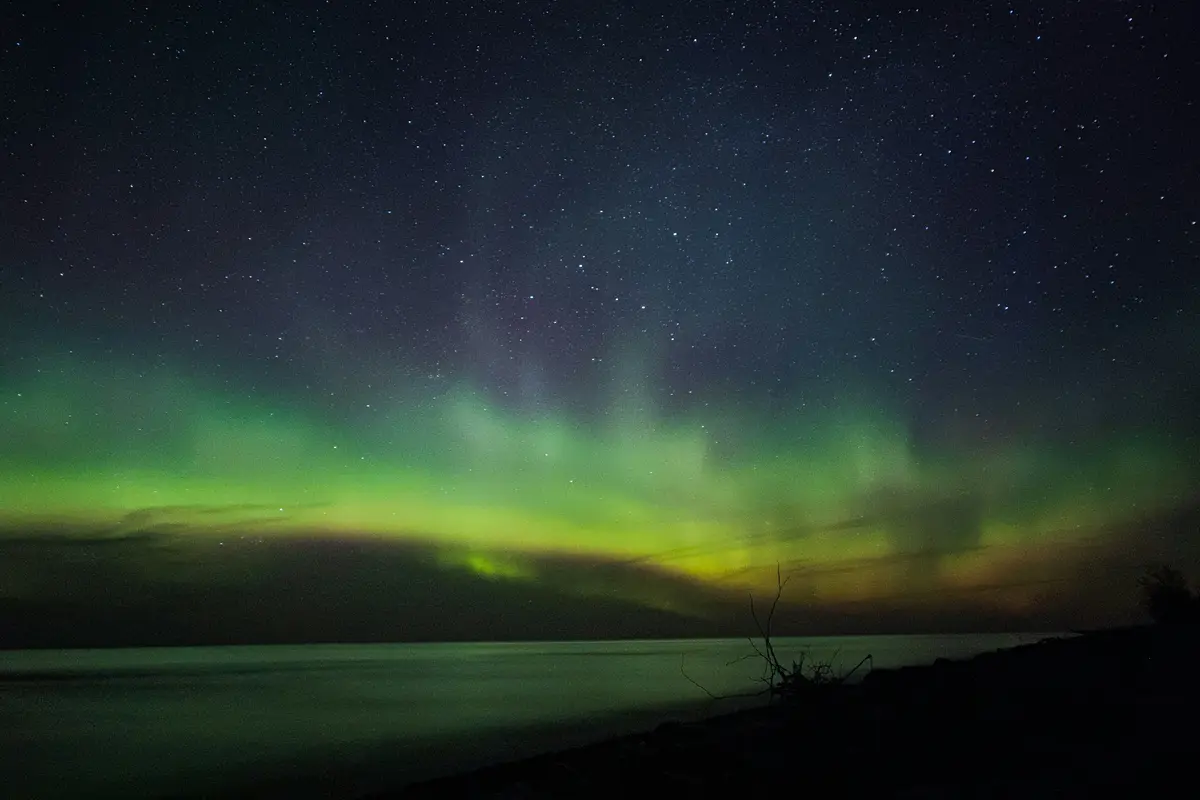
Tonight's northern lights chance across Ohio
NOAA forecasts Kp up to 0.67 during tonight's dark hours, well below the Kp 7 that even Ashtabula typically needs: a quiet night is expected across Ohio.
- Kp now
- 1.67
- Forecast max tonight
- Kp 0.67
- Aurora forecast for
- 1:45 am EDT
| Town | Aurora chance | Cloud, dark hours | Fully dark (EDT) | Kp usually needed | Outlook |
|---|---|---|---|---|---|
| AshtabulaLake Erie, northeast Ohio | 0% | 30% | 7:55 pm – 6:18 am | Kp 7 (G3) | Unlikely |
| ToledoLake Erie, northwest Ohio | 0% | 0% | 8:06 pm – 6:30 am | Kp 7 (G3) | Unlikely |
| ClevelandLake Erie shore | 0% | 13% | 7:59 pm – 6:22 am | Kp 7 (G3) | Unlikely |
| SanduskyLake Erie, Erie County | 0% | 0% | 8:03 pm – 6:26 am | Kp 7 (G3) | Unlikely |
| AkronNortheast Ohio | 0% | 29% | 7:58 pm – 6:21 am | Kp 7 (G3) | Unlikely |
| MansfieldNorth-central Ohio | 0% | 27% | 8:02 pm – 6:25 am | Kp 8 (G4) | Unlikely |
| ColumbusCentral Ohio | 0% | 34% | 8:04 pm – 6:27 am | Kp 8 (G4) | Unlikely |
| DaytonSouthwest Ohio | 0% | 38% | 8:09 pm – 6:32 am | Kp 8 (G4) | Unlikely |
| MariettaOhio River, southeast Ohio | 0% | 44% | 7:58 pm – 6:20 am | Kp 8 (G4) | Unlikely |
| CincinnatiOhio River, southwest Ohio | 0% | 25% | 8:11 pm – 6:33 am | Kp 8 (G4) | Unlikely |
Aurora chance is NOAA's OVATION model, which NOAA describes as a 30 to 90 minute forecast, so in daylight it shows where the oval is now rather than tonight; this page rebuilds every 30 minutes, so check back after dark. Cloud is MET Norway's forecast averaged over the rest of tonight's dark hours. Weather data from MET Norway (CC BY 4.0).
Check your own spot in Ohio
Not near one of these towns? Enter a ZIP code or share your location for the same check at your exact point. ZIP codes resolve from the Census Bureau's ZIP code areas on this site's own server.
Combines tonight's aurora activity, your latitude, and your local cloud cover into one answer.
What Kp does Ohio need for the northern lights?
Ohio is far enough south that only a strong storm brings the aurora into view. The geomagnetic pole over the Canadian Arctic does help: every Ohio town sits several degrees closer to it in geomagnetic terms than its map latitude suggests. Even so, no Ohio town reaches the band NOAA ties to a G2 storm. The Lake Erie shore and the northeast, Toledo, Cleveland and Akron included, sit just inside the G3 band; from Mansfield south, Columbus, Dayton and Cincinnati included, it takes a G4 storm.
| Town | Map latitude | Geomagnetic latitude | Typical storm level |
|---|---|---|---|
| Ashtabula | 41.9°N | 51.0° | G3, Kp 7 |
| Toledo | 41.7°N | 50.7° | G3, Kp 7 |
| Cleveland | 41.5°N | 50.6° | G3, Kp 7 |
| Sandusky | 41.5°N | 50.5° | G3, Kp 7 |
| Akron | 41.1°N | 50.2° | G3, Kp 7 |
| Mansfield | 40.8°N | 49.8° | G4, Kp 8 |
| Columbus | 40.0°N | 49.0° | G4, Kp 8 |
| Dayton | 39.8°N | 48.8° | G4, Kp 8 |
| Marietta | 39.4°N | 48.5° | G4, Kp 8 |
| Cincinnati | 39.1°N | 48.1° | G4, Kp 8 |
How rare is that? NOAA's storm scale counts about 130 storm days per 11-year solar cycle at the G3 level and about 60 at G4. Those are storm days, not sightings: a storm still has to fall on a clear night, during Ohio's dark hours, to be seen, and on most nights the table above will read Unlikely across the state.
How the column is worked out: each town's geomagnetic latitude uses the dipole terms of the IGRF-14 field model for 2025, which place the north geomagnetic pole near 80.8°N, 72.8°W. NOAA's storm scale then gives the lowest geomagnetic latitude where the aurora has typically been seen: 55° at G2 (Kp 6), 50° at G3 (Kp 7), 45° at G4 (Kp 8) and 40° at G5 (Kp 9). These are typical values, not guarantees: NOAA's viewing tips call its Kp-to-latitude relationships approximate averages.
Where to watch the northern lights in Ohio
Get away from city light and find an open view to the north, where a display seen from Ohio usually sits low. Two places with dark skies and public access:
Geauga Observatory Park International Dark Sky Park
Montville Township, Geauga County, northeast Ohio
Designated by DarkSky International in 2011, with an observatory and telescopes on a 418-hectare preserve. It sits in the G3 band (Kp 7), like Cleveland.
John Glenn Astronomy Park Dark-sky observing site
Hocking Hills State Park, near Logan, southeast Ohio
A project of the Friends of the Hocking Hills State Park, with public programs on Friday and Saturday nights from early March through Thanksgiving; a free parking pass is required. In southern Ohio it takes a G4 storm (Kp 8).
Source: John Glenn Astronomy Park: FAQ
Best time to see the northern lights in Ohio
NOAA's Space Weather Prediction Center says the best seasons for aurora watching are around the spring and fall equinoxes. In Ohio the storm matters more than the season: only a G3 or stronger storm typically reaches the state, so watch NOAA's Kp forecast rather than the calendar.
Within a night, NOAA says the best aurora is usually within an hour or two of midnight, between 10 PM and 2 AM local time. Pair that with the dark window in the live table above: the hours before the end of astronomical twilight wash out a faint display.
Ohio northern lights FAQ
Can you see the northern lights in Ohio tonight?
The live table on this page answers that for 10 Ohio towns: NOAA's aurora chance, the cloud cover forecast over the dark hours and when full darkness starts. It rebuilds every 30 minutes. A town is marked an outside chance from 8% and a good chance from 20%, if the sky is clear enough to see it.
What time can you see the northern lights in Ohio?
After full darkness and, per NOAA, usually within an hour or two of midnight: between 10 PM and 2 AM local time. The table lists tonight's dark window for each town, from the end of astronomical twilight to the first light of dawn.
Can you see the northern lights in Columbus?
On strong nights. Columbus sits at about 49° geomagnetic latitude, which NOAA's storm scale puts in the G4 band (Kp 8), the level at which NOAA says the aurora "has been seen as low as Alabama and northern California". On quieter nights it stays north of the city; even on a strong night, city light washes out a faint display, so a dark spot with an open northern horizon helps.
Why can you see the northern lights in Ohio?
Because the north geomagnetic pole is not at the North Pole: in the IGRF-14 model it sits near 80.8°N, 72.8°W, over the Canadian Arctic. That puts Ashtabula at about 51° geomagnetic latitude against 41.9° on the map, and the aurora oval follows geomagnetic latitude.
Can you see the northern lights in Cleveland?
In strong storms. Cleveland sits at about 50.6° geomagnetic latitude, just inside the band NOAA ties to a G3 storm (Kp 7), the level at which NOAA says the aurora "has been seen as low as Illinois and Oregon". Look north over Lake Erie from somewhere away from the city lights.
Can you see the northern lights in Cincinnati?
Only in a severe storm. Cincinnati sits at about 48.1° geomagnetic latitude, in the band NOAA ties to a G4 storm (Kp 8), the level at which NOAA says the aurora "has been seen as low as Alabama and northern California".
Where is the best place to see the northern lights in Ohio?
The north of the state, away from city light, looking north. The Lake Erie shore needs a G3 storm, a step below the G4 that central and southern Ohio need. Geauga Observatory Park in northeast Ohio is an International Dark Sky Park (DarkSky International, 2011); in the south, the John Glenn Astronomy Park in Hocking Hills State Park is a dark site with public programs.
How often can you see the northern lights in Ohio?
Rarely. No official count of sightings exists for the state, but NOAA publishes how often storms reach each level: about 130 storm days per 11-year solar cycle at G3, the level northern Ohio typically needs, and about 60 at G4, the level for Columbus, Dayton and Cincinnati. Cloud and daylight rule out many of those.
How is this Ohio aurora forecast worked out?
For each town, the aurora chance is NOAA's OVATION model at that 1° grid cell, which NOAA describes as a 30 to 90 minute forecast. Cloud cover is MET Norway's hourly forecast averaged over the rest of tonight's dark hours. Dark hours are computed from the sun's position. The Kp each town needs comes from its geomagnetic latitude and NOAA's storm scale.
Sources
Every claim on this page is backed by an authoritative source. Atlas Ranger synthesizes data from multiple references so you can see exactly where each fact came from.
- NOAA SWPC: Aurora 30-Minute Forecast (OVATION)Used for: Aurora probability at each town, refreshed with every page rebuild · NOAA describes it as a 30 to 90 minute forecast of the aurora’s location and intensity
- NOAA SWPC: Planetary K-index and 3-Day ForecastUsed for: Current Kp and the highest forecast Kp over tonight’s dark hours
- NOAA Space Weather Scales (geomagnetic storms)Used for: Typical lowest geomagnetic latitude of the aurora at each storm level (G2 55°, G3 50°, G4 45°, G5 40°) and average storm days per solar cycle · Read 2026-10-24
- NOAA SWPC: Tips on Viewing the AuroraUsed for: Best time of night (10 PM–2 AM) and season (around the equinoxes); guidance is in geomagnetic latitude · Read 2026-10-24
- IGRF-14 coefficients (NOAA NCEI / IAGA)Used for: Geomagnetic pole position (2025.0 dipole terms) for each town’s geomagnetic latitude · Read 2026-10-24
- MET Norway Locationforecast 2.0Used for: Hourly cloud cover at each town, averaged over the dark hours · Weather data from MET Norway, licensed CC BY 4.0; cached 30 minutes
- US Census Bureau 2024 Gazetteer FilesUsed for: Town coordinates (Places file) and ZIP code points (ZCTA file) · Public domain; read 2026-10-24
- DarkSky International: Geauga Observatory ParkUsed for: Where to watch in Ohio · Read 2026-10-25
- John Glenn Astronomy Park: FAQUsed for: Where to watch in Ohio · Read 2026-10-25