Live · Updated Thu, 11:27 PM CDT · refreshes every 30 min
Northern lights tonight in Minnesota
Is there a chance of the northern lights in Minnesota tonight? The table below covers nine towns, from International Falls on the Canadian border and Grand Marais on the North Shore down to the Twin Cities and Rochester, with cloud cover over the dark hours and when full darkness starts. It rebuilds every 30 minutes from NOAA's aurora model and MET Norway's cloud forecast.
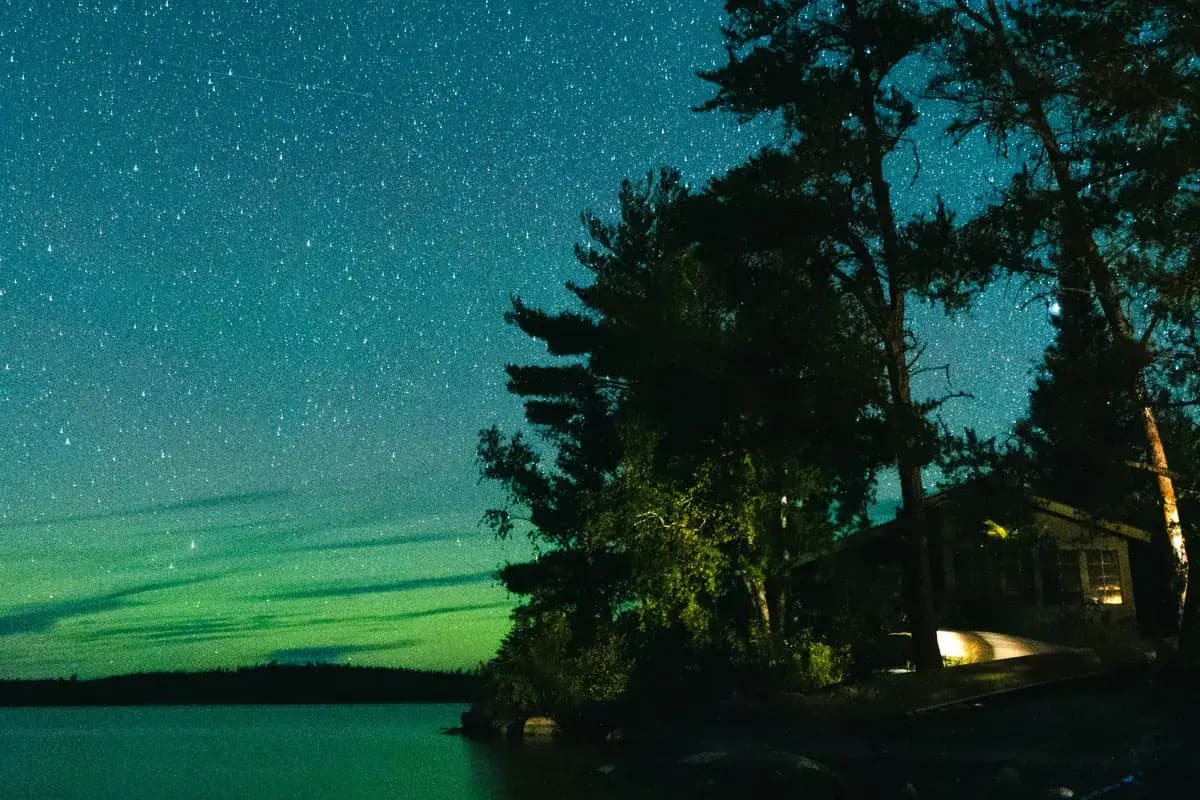
Tonight's northern lights chance across Minnesota
NOAA forecasts Kp up to 0.67 during tonight's dark hours, well below the Kp 6 that even International Falls typically needs: a quiet night is expected across Minnesota.
- Kp now
- 1.67
- Forecast max tonight
- Kp 0.67
- Aurora forecast for
- 12:45 am CDT
| Town | Aurora chance | Cloud, dark hours | Fully dark (CDT) | Kp usually needed | Outlook |
|---|---|---|---|---|---|
| International FallsCanadian border | 0% | 16% | 7:45 pm – 6:10 am | Kp 6 (G2) | Unlikely |
| ElyNortheast Minnesota | 0% | 13% | 7:39 pm – 6:04 am | Kp 6 (G2) | Unlikely |
| Grand MaraisNorth Shore, Cook County | 0% | 59% | 7:33 pm – 5:58 am | Kp 6 (G2) | Unlikely |
| BemidjiNorthern Minnesota | 0% | 85% | 7:51 pm – 6:16 am | Kp 6 (G2) | Unlikely |
| DuluthLake Superior | 0% | 56% | 7:40 pm – 6:05 am | Kp 6 (G2) | Unlikely |
| BrainerdCentral lakes | 0% | 92% | 7:48 pm – 6:13 am | Kp 7 (G3) | Unlikely |
| St. CloudCentral Minnesota | 0% | 95% | 7:48 pm – 6:13 am | Kp 7 (G3) | Unlikely |
| MinneapolisTwin Cities | 0% | 85% | 7:45 pm – 6:09 am | Kp 7 (G3) | Unlikely |
| RochesterSoutheast Minnesota | 0% | 20% | 7:42 pm – 6:06 am | Kp 7 (G3) | Unlikely |
Aurora chance is NOAA's OVATION model, which NOAA describes as a 30 to 90 minute forecast, so in daylight it shows where the oval is now rather than tonight; this page rebuilds every 30 minutes, so check back after dark. Cloud is MET Norway's forecast averaged over the rest of tonight's dark hours. Weather data from MET Norway (CC BY 4.0).
Check your own spot in Minnesota
Not near one of these towns? Enter a ZIP code or share your location for the same check at your exact point. ZIP codes resolve from the Census Bureau's ZIP code areas on this site's own server.
Combines tonight's aurora activity, your latitude, and your local cloud cover into one answer.
What Kp does Minnesota need for the northern lights?
The north geomagnetic pole sits over the Canadian Arctic, so Minnesota towns are several degrees closer to it in geomagnetic terms than their map latitude suggests, and that is the latitude NOAA's aurora guidance uses. Everything from Duluth north falls in the band NOAA ties to a G2 storm; Brainerd, St. Cloud, the Twin Cities and Rochester fall in the G3 band.
| Town | Map latitude | Geomagnetic latitude | Typical storm level |
|---|---|---|---|
| International Falls | 48.6°N | 57.1° | G2, Kp 6 |
| Ely | 47.9°N | 56.5° | G2, Kp 6 |
| Grand Marais | 47.8°N | 56.4° | G2, Kp 6 |
| Bemidji | 47.5°N | 55.9° | G2, Kp 6 |
| Duluth | 46.8°N | 55.4° | G2, Kp 6 |
| Brainerd | 46.4°N | 54.8° | G3, Kp 7 |
| St. Cloud | 45.5°N | 54.0° | G3, Kp 7 |
| Minneapolis | 45.0°N | 53.5° | G3, Kp 7 |
| Rochester | 44.0°N | 52.6° | G3, Kp 7 |
How the column is worked out: each town's geomagnetic latitude uses the dipole terms of the IGRF-14 field model for 2025, which place the north geomagnetic pole near 80.8°N, 72.8°W. NOAA's storm scale then gives the lowest geomagnetic latitude where the aurora has typically been seen: 55° at G2 (Kp 6), 50° at G3 (Kp 7), 45° at G4 (Kp 8) and 40° at G5 (Kp 9). These are typical values, not guarantees: NOAA's viewing tips call its Kp-to-latitude relationships approximate averages.
Where to watch the northern lights in Minnesota
Minnesota has two DarkSky International designations, both in the far north, and the state tourism office, Explore Minnesota, points aurora watchers to the same corner of the state. Its advice for framing a display: the south shore of an inland lake, looking north across the water.
Boundary Waters Canoe Area Wilderness International Dark Sky Sanctuary
Superior National Forest, northeast Minnesota
Certified in September 2020 as the first DarkSky place in Minnesota. Explore Minnesota notes it is reached primarily by canoe.
Source: DarkSky International: Boundary Waters named a Dark Sky Sanctuary (2020-09-15)
Voyageurs National Park International Dark Sky Park
Northern Minnesota
Certified in December 2020, and on the National Park Service's list of parks for aurora viewing.
Source: DarkSky International: Voyageurs certified as an International Dark Sky Park (2020-12-07)
Cook County and the Gunflint Trail North Shore of Lake Superior
Grand Marais and inland along the Gunflint Trail
Explore Minnesota says visitors here can frequently see the sky lit up over Lake Superior and along the trail.
Source: Explore Minnesota: Where to See the Northern Lights in Minnesota
Lake of the Woods and the Northwest Angle Far northern Minnesota
Canadian border; the Angle is the northernmost point of the contiguous US
Named by Explore Minnesota for open views of water, forest and, some nights, the northern lights.
Source: Explore Minnesota: Where to See the Northern Lights in Minnesota
Best time to see the northern lights in Minnesota
NOAA's Space Weather Prediction Center says the best seasons for aurora watching are around the spring and fall equinoxes. Explore Minnesota notes that fall and winter are popular for their long nights but that no single season is especially likely to bring a display: the space weather decides.
Within a night, NOAA says the best aurora is usually within an hour or two of midnight, between 10 PM and 2 AM local time. Pair that with the dark window in the live table above: the hours before the end of astronomical twilight wash out a faint display.
Minnesota northern lights FAQ
Can you see the northern lights in Minnesota tonight?
The live table on this page answers that for 9 Minnesota towns: NOAA's aurora chance, the cloud cover forecast over the dark hours and when full darkness starts. It rebuilds every 30 minutes. A town is marked an outside chance from 8% and a good chance from 20%, if the sky is clear enough to see it.
What time can you see the northern lights in Minnesota?
After full darkness and, per NOAA, usually within an hour or two of midnight: between 10 PM and 2 AM local time. The table lists tonight's dark window for each town, from the end of astronomical twilight to the first light of dawn.
Can you see the northern lights in Minneapolis?
On strong nights. Minneapolis sits at about 53° geomagnetic latitude, which NOAA's storm scale puts in the G3 band (Kp 7), the level at which NOAA says the aurora "has been seen as low as Illinois and Oregon". On quieter nights it stays north of the city; even on a strong night, city light washes out a faint display, so a dark spot with an open northern horizon helps.
Why can you see the northern lights in Minnesota?
Because the north geomagnetic pole is not at the North Pole: in the IGRF-14 model it sits near 80.8°N, 72.8°W, over the Canadian Arctic. That puts International Falls at about 57° geomagnetic latitude against 48.6° on the map, and the aurora oval follows geomagnetic latitude.
Where is the best place to see the northern lights in Minnesota?
The far north. Minnesota's two DarkSky International designations are the Boundary Waters Canoe Area Wilderness (a Dark Sky Sanctuary) and Voyageurs National Park (a Dark Sky Park). Explore Minnesota also points to Cook County and the Gunflint Trail, Lake of the Woods and the Northwest Angle, and suggests the south shore of an inland lake for a clear view north.
When is the best time of year to see the northern lights in Minnesota?
NOAA says the best seasons are around the spring and fall equinoxes; Explore Minnesota adds that fall and winter are popular for their long nights, though no season guarantees a display. Within a night, NOAA says the best aurora is usually between 10 PM and 2 AM local time.
How is this Minnesota aurora forecast worked out?
For each town, the aurora chance is NOAA's OVATION model at that 1° grid cell, which NOAA describes as a 30 to 90 minute forecast. Cloud cover is MET Norway's hourly forecast averaged over the rest of tonight's dark hours. Dark hours are computed from the sun's position. The Kp each town needs comes from its geomagnetic latitude and NOAA's storm scale.
Sources
Every claim on this page is backed by an authoritative source. Atlas Ranger synthesizes data from multiple references so you can see exactly where each fact came from.
- NOAA SWPC: Aurora 30-Minute Forecast (OVATION)Used for: Aurora probability at each town, refreshed with every page rebuild · NOAA describes it as a 30 to 90 minute forecast of the aurora’s location and intensity
- NOAA SWPC: Planetary K-index and 3-Day ForecastUsed for: Current Kp and the highest forecast Kp over tonight’s dark hours
- NOAA Space Weather Scales (geomagnetic storms)Used for: Typical lowest geomagnetic latitude of the aurora at each storm level (G2 55°, G3 50°, G4 45°, G5 40°) and average storm days per solar cycle · Read 2026-10-24
- NOAA SWPC: Tips on Viewing the AuroraUsed for: Best time of night (10 PM–2 AM) and season (around the equinoxes); guidance is in geomagnetic latitude · Read 2026-10-24
- IGRF-14 coefficients (NOAA NCEI / IAGA)Used for: Geomagnetic pole position (2025.0 dipole terms) for each town’s geomagnetic latitude · Read 2026-10-24
- MET Norway Locationforecast 2.0Used for: Hourly cloud cover at each town, averaged over the dark hours · Weather data from MET Norway, licensed CC BY 4.0; cached 30 minutes
- US Census Bureau 2024 Gazetteer FilesUsed for: Town coordinates (Places file) and ZIP code points (ZCTA file) · Public domain; read 2026-10-24
- DarkSky International: Boundary Waters named a Dark Sky Sanctuary (2020-09-15)Used for: Where to watch in Minnesota · Read 2026-10-24
- DarkSky International: Voyageurs certified as an International Dark Sky Park (2020-12-07)Used for: Where to watch in Minnesota · Read 2026-10-24
- Explore Minnesota: Where to See the Northern Lights in MinnesotaUsed for: Where to watch in Minnesota · Read 2026-10-24